
Publications and Media
Conference talks
NEMO collaborators present at conferences around the world. Catch up on our progress with this archive of slides.
Latest results from NEMO-3 and commissioning status of the SuperNEMO demonstrator
presented by Thibaud Le Noblet at TAUP2017, Sudbury, Canada, 28 July 2017
Radon emanation studies in the SuperNEMO double beta decay experiment
presented by Christophe Hugon at Rencontres du Vietnam 2017, Quy Nhon, Vietnam, 16 July 2017
Search for neutrinoless double-beta decay with the SuperNEMO demonstrator
presented by Carla Macolino at EPS-HEP2017, Venice, Italy, 07 July 2017
The NEMO-3 and SuperNEMO experiments
presented by Michele Cascella at TIPP 2017, Beijing, China, 22 May 2017
$0\nu\beta\beta$ sensitivity with the SuperNEMO demonstrator
presented by Steven Calvez at 52nd Rencontres de Moriond, YSF, La Thuile, Italy, 18 March 2017
Recent results from NEMO-3 and status of SuperNEMO
presented by Cristovao Vilela at DBD16, Osaka, Japan, 08 November 2016
Status of SuperNEMO Demonstrator
presented by Frédéric Perrot at ICHEP 2016, Chicago, USA, 05 August 2016
Latest results from NEMO-3 and status of the SuperNEMO Neutrinoless Double-Beta Decay experiment
presented by David Waters at Neutrino 2016, London, UK, 08 July 2016
Radio-purity Strategy for the SuperNEMO Experiment
presented by Xin Ran Liu at IOP, Surrey, UK, 21 March 2016
Investigating $\beta\beta$ decay with NEMO-3 and SuperNEMO
presented by Summer Blot at TAUP 2015, Torino, Italy, 07 September 2015
Topological detection of $\beta\beta$-decay with NEMO-3 and SuperNEMO
presented by Ruben Saakyan at NDM-2015, Jyvaskyla, Finland, 04 June 2015
Ultra-low Level Radon Assays in Gases
presented by Xin Ran Liu at LRT2015, Washington, USA, 18 March 2015
Latest results from NEMO-3 and status of SuperNEMO
presented by Alberto Remoto at NeuTel2015, Venice, Italy, 02 March 2015
The SuperNEMO experiment
presented by Federico Nova at WINP 2015, Brookhaven, USA, 04 February 2015
Search for Neutrinoless Double-$\beta$ Decay of $^{100}$Mo in the final NEMO-3 dataset
presented by Stefano Torre at XLIXth Rencontres de Moriond, La Thuile, Italy, 15 March 2014
The NEMO3 results
presented by Victor Tretyak at Medex 2013, Prague, Czech Republic, 11 June 2013
Posters
SuperNEMO and NEMO-3 posters presented at conferences and schools.
Status of the SuperNEMO 0$\nu\beta\beta$ experiment
presented by Cheryl Patrick and Fang Xie at NuPhys2016, 12 December 2016
Gamma-tracking and sensitivity to gamma-emitting backgrounds in SuperNEMO
presented by Steven Calvez at ICHEP 2016, 05 August 2016
Measurement of the 2$\nu\beta\beta$ decay half-life and search for the 0$\nu\beta\beta$ decay of $^{116}$Cd
presented by Thibaud Le Noblet and Alberto Remoto at Neutrino 2016, 07 July 2016
The SuperNemo $^{82}$Se-source foils radiopurity measurement with the BiPo-3 detector
presented by Pia Loaiza at Neutrino 2016, 07 July 2016
The SuperNEMO Light Injection and Monitoring System
presented by Thibaud Le Noblet, John Cesar, Ramon Salazar at Neutrino 2016, 07 July 2016
High resolution low background calorimeter for SuperNEMO
presented by Christine Marquet and Cedric Cerna at Neutrino 2016, 07 July 2016
Development of an optical simulation for the SuperNEMO calorimeter
presented by Arnaud Huber at Neutrino 2016, 07 July 2016
Construction, commissioning and transport of the tracker module for the SuperNEMO experiment
presented by Lauren Dawson, Ashwin Chopra and Michele Cascella at Neutrino 2016, 07 July 2016
SuperNEMO - a new generation of underground experiments for double beta-decay investigations: background constraints
presented by Pavel Povinec at Vienna Conference on Instrumentation, 15 February 2016
Measurement of extremely low radioactive contaminations for the SuperNEMO project
presented by Arnaud Chapon , 12 August 2010
The SuperNEMO Experiment
presented by Federico Nova at Neutrino 2010, 14 June 2010
The SuperNEMO Experiment
presented by Irina Nasteva at EPS 2009, 22 July 2009
NEMO in the News
Find out what the media has to say about SuperNEMO and NEMO-3.

Plongée au cœur des souterrains artificiels des Alpes, from France 3 Alpes, 28 February 2017
Ils ont été construits pour l'exploitation de ressources minières, la recherche sur les mystères de l'Univers ou la défense contre les bombardements alliés... Les Alpes du Nord regorgent de souterrains façonnés par l'homme. (Emission en français)

L'autre hypothèse : la particule de Majorana, from Sciences et Avenir, 01 October 2016
L'énigme de l'antimatière pourrait voir sa réponse surgir des montagnes situées à la frontière franco-italienne. Là, sous 1700 mètres de roches, le Laboratoire souterrain de Modane (LSM) est une oasis préservée des particules invisibles bombardant sans cesse la surface de la Terre et traversant notre corps chaque seconde. (Article en français)
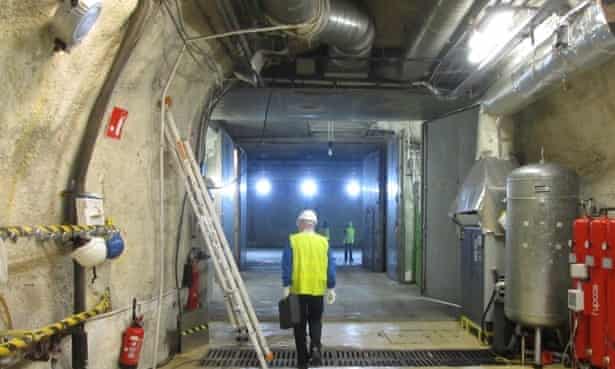
How the particle that led Bohr to think energy might not be conserved could lead the next revolution in physics, from The Guardian, 18 October 2015
Neutrinos are ubiquitous, but mysterious. A Nobel prize was awarded this year for the discovery that they have mass, and undergo quantum oscillations as they travel - discoveries that fundamentally changed our understanding of physics and cosmology. A rare nuclear decay, being searched for now, might lead to a similar revolution...

NEMO closes in on neutrino mass, from phys.org, 20 June 2014
The NEMO (Neutrino Ettore Majorana Observatory) experiment, whose goal was to elucidate the nature of neutrinos and measure their mass, yielded very positive results. The product of an extensive international collaboration including seven CNRS joint laboratories1, the detector, installed in the Modane Underground Laboratory (CNRS/CEA) in the Fréjus road tunnel, ran from 2003 to 2011...

Interview de Fabrice Piquemal, porte-parole de SuperNEMO et directeur du LSM (en francais), from Radio France Internationale, 01 January 2009
Interview de Fabrice Piquemal, directeur du LSM par Dominique Desaunay de Radio France Internationale au labo en 2009...

Video - the lab as if you were there, from LSM, 01 January 2005
Video from 2005 of a visit to the LSM underground lab, where NEMO-3 was installed. 10 minutes, no narration.
SuperNEMO Papers
Journal papers from the SuperNEMO experiment.
The BiPo-3 detector for the measurement of ultra low natural radioactivities of thin materials
JINST 12 (2017) P06002 (arXiv 1005.0343), 01 June 2017
Abstract
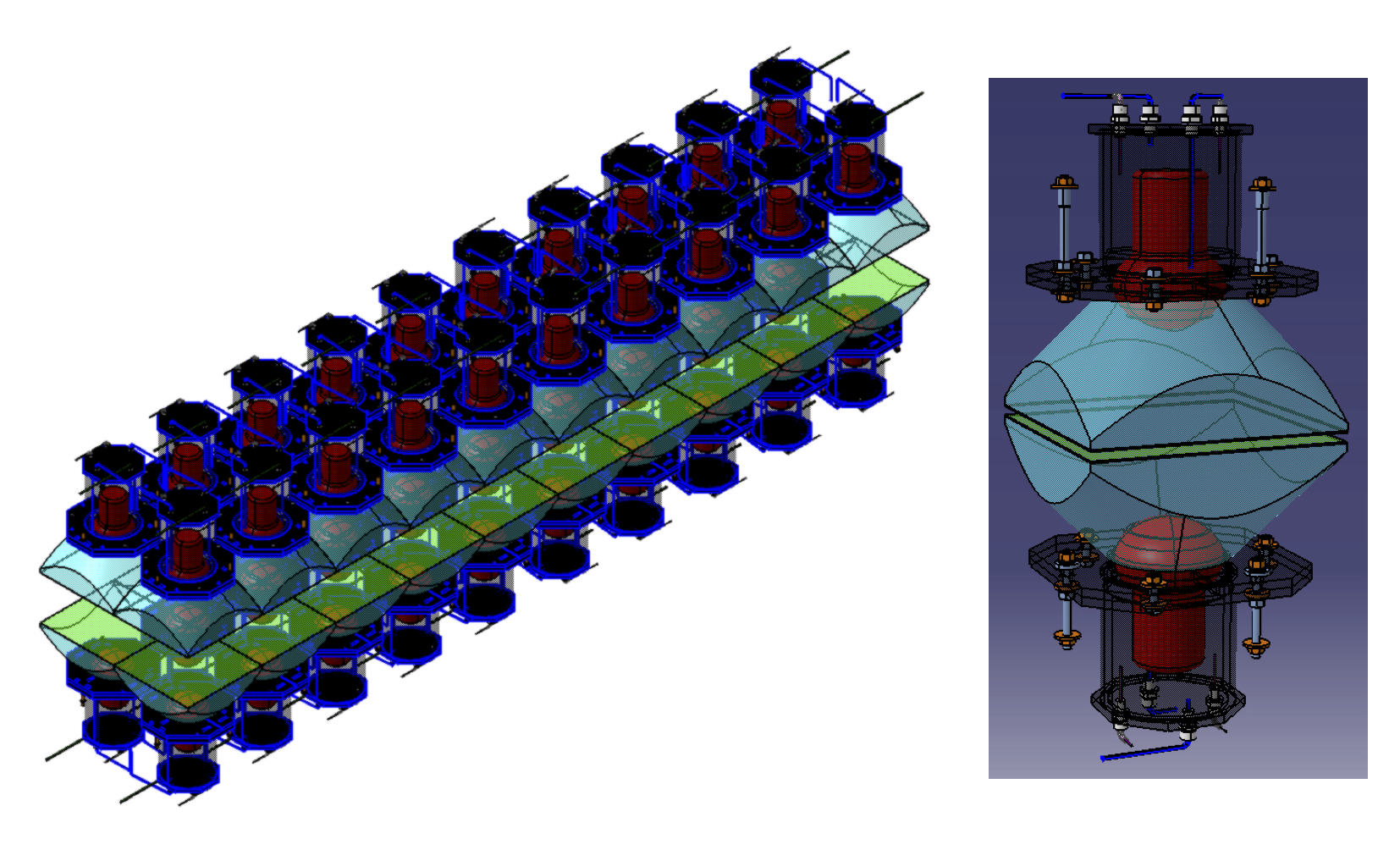
The BiPo-3 detector, running at the Canfranc Underground Laboratory (Laboratorio Subterráneo de Canfranc, LSC, Spain) since 2013, is a low-radioactivity detector dedicated to measuring ultra low natural radionuclide contaminations of $^{208}$Tl ($^{232}$Th chain) and $^{214}$Bi ($^{238}$U chain) in thin materials. The total sensitive surface area of the detector is 3.6m$^2$. The detector has been developed to measure the radiopurity of the selenium double $\beta$-decay source foils of the SuperNEMO experiment. In this paper the design and performance of the detector, and results of the background measurements in $^{208}$Tl and $^{214}$Bi, are presented, and the validation of the BiPo-3 measurement with a calibrated aluminium foil is discussed. Results of the $^{208}$Tl and $^{214}$Bi activity measurements of the first enriched $^{82}$Se foils of the double $\beta$-decay SuperNEMO experiment are reported. The sensitivity of the BiPo-3 detector for the measurement of the SuperNEMO $^{82}$Se foils is $\mathcal{A}$($^{208}$Tl) $<2$ $\mu$Bq/kg (90% C.L.) and $\mathcal{A}$($^{214}$Bi) $<140$ $\mu$Bq/kg (90% C.L.) after 6 months of measurement.
Spectral modeling of scintillator for the NEMO-3 and SuperNEMO detectors
Nucl.Inst.Meth. A 625(1) 20-28 (arXiv 1004.3779), 01 January 2011
Abstract
We have constructed a GEANT4-based detailed software model of photon transport in plastic scintillator blocks and have used it to study the NEMO-3 and SuperNEMO calorimeters employed in experiments designed to search for neutrinoless double beta decay. We compare our simulations to measurements using conversion electrons from a calibration source of $^{207}$Bi and show that the agreement is improved if wavelength-dependent properties of the calorimeter are taken into account. In this article, we briefly describe our modeling approach and results of our studies.
The SuperNEMO project
Eur. Phys. J. C (2010) 70: 927. (arXiv 1005.1241), 18 November 2010
Abstract
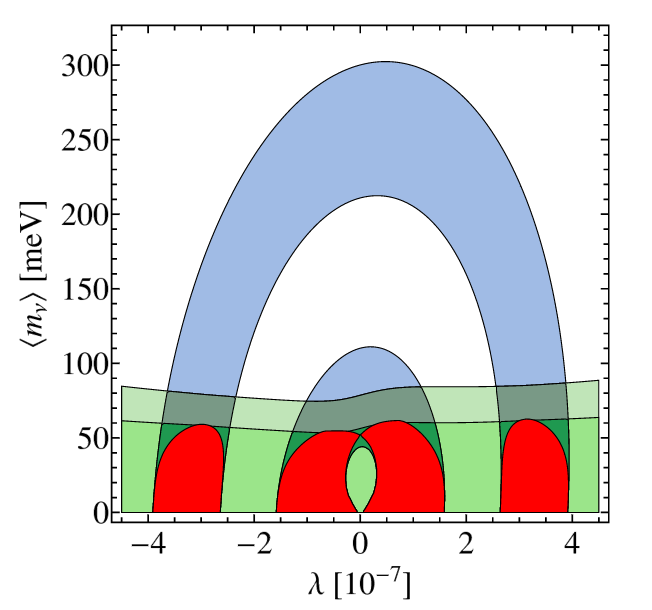
The possibility to probe new physics scenarios of light Majorana neutrino exchange and right-handed currents at the planned next generation neutrinoless double $\beta$ decay experiment SuperNEMO is discussed. Its ability to study different isotopes and track the outgoing electrons provides the means to discriminate different underlying mechanisms for the neutrinoless double $\beta$ decay by measuring the decay half-life and the electron angular and energy distributions.
Results of the BiPo-1 prototype for radiopurity measurements for the SuperNEMO double beta decay source foils
Nucl.Inst.Meth. A 622(1) 120–128 (arXiv 1005.0343), 01 October 2010
Abstract
The development of BiPo detectors is dedicated to the measurement of extremely high radiopurity in $^{208}$Tl and $^{214}$Bi for the SuperNEMO double beta decay source foils. A modular prototype, called BiPo-1, with 0.8 m$^2$ of sensitive surface area, has been running in the Modane Underground Laboratory since February, 2008. The goal of BiPo-1 is to measure the different components of the background and in particular the surface radiopurity of the plastic scintillators that make up the detector. The first phase of data collection has been dedicated to the measurement of the radiopurity in $^{208}$Tl. After more than one year of background measurement, a surface activity of the scintillators of $\mathcal{A}(^{208}\textrm{Tl})=1.5\mu$ Bq/m$^2$ is reported here. Given this level of background, a larger BiPo detector having 12 m$^2$ of active surface area, is able to qualify the radiopurity of the SuperNEMO selenium double beta decay foils with the required sensitivity of $\mathcal{A}(^{208}\textrm{Tl})<2\mu$ Bq/kg (90% C.L.) with a six month measurement.
The SuperNEMO project
Physics of Atomic Nuclei, Volume 69, Issue 12, pp.2096-2100 , 23 November 2005
Abstract
Neutrinoless double-beta decay ($\beta\beta (0 \nu)$) is the most sensitive process in the search for leptonic number violation and its discovery would prove that the neutrino is a Majorana particle. From the experience of the NEMO-3 detector construction and data analysis, the NEMO Collaboration proposes a three-year R&D program in order to design a detector (SuperNEMO) sensitive to a $\beta\beta (0 \nu)$ period of few 10$^{26}$ yr coupling track reconstruction and calorimeter.
NEMO-3 Papers
Papers from SuperNEMO's predescessor, NEMO-3.
Search for Neutrinoless Quadruple-β Decay of $^{150}$Nd with the NEMO-3 Detector
Phys. Rev. Lett. 119, 041801 (arXiv 1705.08847), 24 July 2017
Abstract
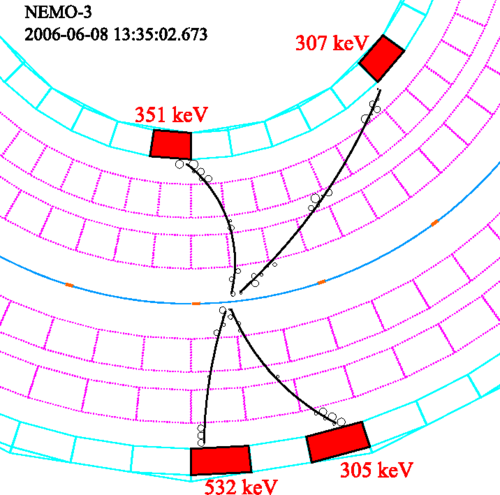
We report the results of a first experimental search for lepton number violation by four units in the neutrinoless quadruple-$\beta$ decay of $^{150}$Nd using a total exposure of $0.19$ kg$\cdot$y recorded with the NEMO-3 detector at the Modane Underground Laboratory (LSM). We find no evidence of this decay and set lower limits on the half-life in the range $T_{1/2}>(1.1\text{-}3.2)\times10^{21}$ y at the $90\%$ CL, depending on the model used for the kinematic distributions of the emitted electrons.
Measurement of the 2νββ decay half-life and search for the 0νββ decay of 116Cd with the NEMO-3 detector
Phys. Rev. D 95, 012007 (arXiv 1610.03226), 17 January 2017
Abstract
The NEMO-3 experiment measured the half-life of the 2$\nu\beta\beta$ decay and searched for the 0$\nu\beta\beta$ decay of $^{116}$Cd. Using 410 g of $^{116}$Cd installed in the detector with an exposure of 5.26 y, (4968$\pm$74) events corresponding to the 2$\nu\beta\beta$ decay of $^{116}$Cd to the ground state of $^{116}$Sn have been observed with a signal to background ratio of about 12. The half-life of the 2$\nu\beta\beta$ decay has been measured to be $T^{2\nu}_{1/2} = \left[2.74 \pm 0.04(\textrm{stat}) \pm0.18 (\textrm{syst})\right]\times 10^{19}$ y. No events have been observed above the expected background while searching for 0$\nu\beta\beta$ decay. The corresponding limit on the half-life is determined to be $T_{1/2}^{0\nu}\geq 1.0\times 10^{23}$ y at the 90 C.L. which corresponds to an upper limit on the effective Majorana neutrino mass of $\left < m_\nu \right > \leq 1.4-2.5$ eV depending on the nuclear matrix elements considered. Limits on other mechanisms generating 0$\nu\beta\beta$ decay such as the exchange of R-parity violating supersymmetric particles, right-handed currents and majoron emission are also obtained.
Measurement of the 2νββ decay half-life of $^{150}$Nd and a search for 0νββ decay processes with the full exposure from the NEMO-3 detector
Phys. Rev. D 94, 072003 (arXiv 1606.08494), 11 October 2016
Abstract
We present results from a search for neutrinoless double-$\beta$(0$\nu\beta\beta$) decay using 36.6 g of the isotope $^{150}$Nd with data corresponding to a live time of 5.25 y recorded with the NEMO-3 detector. We construct a complete background model for this isotope, including a measurement of the two-neutrino double-$\beta$ decay half-life of $T^{2\nu}_{1/2} = \left[9.34 \pm 0.22(\textrm{stat})+0.62-0.60 (\textrm{syst})\right]\times 10^{18}$ y for the ground state transition, which represents the most precise result to date for this isotope. We perform a multivariate analysis to search for 0$\nu\beta\beta$ decays in order to improve the sensitivity and, in the case of observation, disentangle the possible underlying decay mechanisms. As no evidence for 0$\nu\beta\beta$ decay is observed, we derive lower limits on half-lives for several mechanisms involving physics beyond the standard model. The observed lower limit, assuming light Majorana neutrino exchange mediates the decay, is $T_{1/2}^{0\nu}\geq 2.0\times 10^{22}$ y at the 90% C.L., corresponding to an upper limit on the effective neutrino mass of $\left < m_\nu \right > \leq 1.6-5.3$ eV.
Measurement of the double-beta decay half-life and search for the neutrinoless double-beta decay of $^{48}$Ca with the NEMO-3 detector
Phys. Rev. D 93, 112008 (arXiv 1604.01710), 14 June 2016
Abstract
The NEMO-3 experiment at the Modane Underground Laboratory investigates the double-beta decay of $^{48}$Ca. Using 5.25 yr of data recorded with a 6.99 g sample of $^{48}$Ca, approximately 150 double-beta decay candidate events are selected with a signal-to-background ratio greater than 3. The half-life for the two-neutrino double-beta decay of $^{48}$Ca is measured to be $T^{2\nu}_{1/2} = \left[6.4 ^{+0.7}_{-0.6}(\textrm{stat})^{+1.2}_{-0.9} (\textrm{syst})\right]\times 10^{19}$ yr. A search for neutrinoless double-beta decay of $^{48}$Ca yields a null result, and a corresponding lower limit on the half-life is found to be $T_{1/2}^{0\nu}\geq 2.0\times 10^{22}$ at 90% confidence level, translating into an upper limit on the effective Majorana neutrino mass of $\left < m_{\beta\beta} \right > \leq 6.0-26$ eV, with the range reflecting different nuclear matrix element calculations. Limits are also set on models involving Majoron emission and right-handed currents.
Results of the search for neutrinoless double-β decay in $^{100}$Mo with the NEMO-3 experiment
Phys. Rev. D 92, 072011 (arXiv 1506.05825), 21 October 2015
Abstract
The NEMO-3 detector, which had been operating in the Modane Underground Laboratory from 2003 to 2010, was designed to search for neutrinoless double-$\beta$(0$\nu\beta\beta$) decay. We report the final results of a search for 0$\nu\beta\beta$ decays with 6.914 kg of $^{100}$Mo using the entire NEMO-3 data set with a detector live time of 4.96 yr, which corresponds to an exposure of 34.3 kg yr. We perform a detailed study of the expected background in the 0$\nu\beta\beta$ signal region and find no evidence of 0$\nu\beta\beta$ decays in the data. The level of observed background in the 0$\nu\beta\beta$ signal region $[2.8–3.2]$ MeV is $0.44\pm0.13$ counts/yr/kg, and no events are observed in the interval $[3.2–10]$ MeV. We therefore derive a lower limit on the half-life of 0$\nu\beta\beta$ decays in $^{100}$Mo of $T_{1/2}(0$\nu\beta\beta$)> 1.1\times 10^{24}$ yr at the 90% confidence level, under the hypothesis of decay kinematics similar to that for light Majorana neutrino exchange. Depending on the model used for calculating nuclear matrix elements, the limit for the effective Majorana neutrino mass lies in the range $\left < m_\nu \right > \leq 0.33-0.62$ eV. We also report constraints on other lepton-number violating mechanisms for 0$\nu\beta\beta$ decays.
Search for neutrinoless double-beta decay of $^{100}$Mo with the NEMO-3 detector
Phys. Rev. D 89, 111101(R) (arXiv 1506.05825), 12 June 2014
Abstract
We report the results of a search for the neutrinoless double-$\beta$ decay (0$\nu\beta\beta$) of $^{100}$Mo, using the NEMO-3 detector to reconstruct the full topology of the final state events. With an exposure of 34.7 kg y, no evidence for the 0$\nu\beta\beta$ signal has been found, yielding a limit for the light Majorana neutrino mass mechanism of $T_{1/2}^{0\nu}> 1.1\times 10^{24}$ years (90% C.L.) once both statistical and systematic uncertainties are taken into account. Depending on the nuclear matrix elements this corresponds to an upper limit on the Majorana effective neutrino mass of $\left < m_\nu \right > < 0.3-0.9$ eV (90% C.L.). Constraints on other lepton number violating mechanisms of 0$\nu\beta\beta$ decays are also given. Searching for high-energy double electron events in all suitable sources of the detector, no event in the energy region [3.2–10] MeV is observed for an exposure of $47 \textrm{kg}\cdot\textrm{y}$.
Investigation of double beta decay of $^{100}$Mo to excited states of $^{100}$Ru
Nucl. Phys. A 925 (2014) 25 (arXiv 1402.7196), 07 February 2014
Abstract
Double beta decay of $^{100}$Mo to the excited states of daughter nuclei has been studied using a 600 cm$^3$ low-background HPGe detector and an external source consisting of 2588 g of 97.5% enriched metallic $^{100}$Mo, which was formerly inside the NEMO-3 detector and used for the NEMO-3 measurements of $^{100}$Mo. The half-life for the two-neutrino double beta decay of $^{100}$Mo to the excited $0_1^+$ state in $^{100}$Ru is measured to be $T_{1/2} = \left[7.5 \pm 0.6(\textrm{stat})\pm 0.6 (\textrm{syst})\right]\cdot 10^{20}$ yr. For other ($0\nu + 2 \nu$) transitions to the $2_1^+$, $2_2^+$, $0_2^+$, $2_3^+$ and $0_3^+$ levels in $^{100}$Ru, limits are obtained at the level of $~(0.25-1.1)\cdot 10^{22}$ yr.
Measurement of the ββ Decay Half-Life of $^{130}$Te with the NEMO-3 Detector
Phys. Rev. Lett. 107, 062504 (arXiv 1104.3716), 04 August 2011
Abstract
We report results from the NEMO-3 experiment based on an exposure of 1275 days with 661 g of $^{130}$Te in the form of enriched and natural tellurium foils. The $\beta\beta$ decay rate of $^{130}$Te is found to be greater than zero with a significance of 7.7 standard deviations and the half-life is measured to be $T^{2\nu}_{1/2} = \left[7.0 \pm 0.9(\textrm{stat})\pm 1.1 (\textrm{syst})\right]\times 10^{20} \textrm{yr}$. This represents the most precise measurement of this half-life yet published and the first real-time observation of this decay.
Measurement of the two neutrino double beta decay half-life of Zr-96 with the NEMO-3 detector
Nucl.Phys.A847:168-179 (arXiv 0906.2694), 08 December 2010
Abstract
Using 9.4 g of $^{96}$Zr isotope and 1221 days of data from the NEMO-3 detector corresponding to 0.031 kg y, the obtained 2$\nu\beta\beta$ decay half-life measurement is $T^{2\nu}_{1/2} = \left[2.35 \pm 0.14(\textrm{stat})\pm0.16 (\textrm{syst})\right]\times 10^{19} \textrm{yr}$.Different characteristics of the final state electrons have been studied, such as the energy sum, individual electron energy, and angular distribution. The 2$\nu$ nuclear matrix element is extracted using the measured 2$\nu\beta\beta$ half-life and is $M^{2\nu}=0.049\pm0.002$. Constraints on 0$\nu\beta\beta$ decay have also been set.
Measurement of the Double Beta Decay Half-life of $^{150}$Nd and Search for Neutrinoless Decay Modes with the NEMO-3 Detector
Phys. Rev. C 80, 032501(R) (arXiv 0810.0248), 03 September 2009
Abstract
The half-life for double-$\beta$ decay of $^{150}$Nd has been measured by the NEMO-3 experiment at the Modane Underground Laboratory. Using 924.7 days of data recorded with 36.55g of $^{150}$Nd, we measured the half-life for 2$\nu\beta\beta$ decay to be $T^{2\nu}_{1/2} = \left[9.11 ^{+0.25}_{-0.22}(\textrm{stat})\pm0.63 (\textrm{syst})\right]\times 10^{18} \textrm{yr}$. The observed limit on the half-life for neutrinoless double-$\beta$ decay is found to be $T_{1/2}^{0\nu}>1.8\times 10^{22}$ yr at 90% confidence level. This translates into a limit on the effective Majorana neutrino mass of $\left < m_\nu \right > <4.0-6.3$ eV if the nuclear deformation is taken into account. We also set limits on models involving Majoron emission, right-handed currents, and transitions to excited states.
Measurement of the background in the NEMO 3 double beta decay experiment
Nucl. Inst. Meth. A 606, Issue 3 449-465 (arXiv 0903.2277), 21 July 2009
Abstract
In the double beta decay experiment NEMO 3 a precise knowledge of the background in the signal region is of outstanding importance. This article presents the methods used in NEMO 3 to evaluate the backgrounds resulting from most if not all possible origins. It also illustrates the power of the combined tracking-calorimetry technique used in the experiment.
Measurement of double beta decay of $^{100}$Mo to excited states in the NEMO 3 experiment
Nucl. Phys. A 781 209-226 (arXiv hep-ex/0609058), 01 January 2007
Abstract
The double beta decay of $^{100}$Mo to the $0_1^+$ and $2_1^+$ excited states of $^{100}$Ru is studied using the NEMO 3 data. After the analysis of 8024 h of data the half-life for the two-neutrino double beta decay of $^{100}$Mo to the excited $0_1^+$ state is measured to be $T^{2\nu}_{1/2} = \left[5.7 ^{+1.3}_{-0.9}(\textrm{stat})\pm0.8 (\textrm{syst})\right]\times 10^{20} \textrm{y}$. The signal-to-background ratio is equal to 3. Information about energy and angular distributions of emitted electrons is also obtained. No evidence for neutrinoless double beta decay to the excited $0_1^+$ state has been found. The corresponding half-life limit is $T_{1/2}^{(0\nu)}(0^+ \to 0_1^+)>8.9\times 10^{22}$ y (at 90% C.L.). The search for the double beta decay to the $2_1^+$ excited state has allowed the determination of limits on the half-life for the two neutrino mode $T_{1/2}^{(2\nu)}(0^+ \to 2_1^+)>1.1\times 10^{21}$ y (at 90% C.L.) and for the neutrinoless mode $T_{1/2}^{(0\nu)}(0^+ \to 2_1^+)>1.6\times 10^{23}$ y (at 90% C.L.).
Limits on different Majoron decay modes of $^{100}$Mo and $^{82}$Se for neutrinoless double beta decays in the NEMO-3 experiment
Nucl.Phys. A 765 (2006) 483-494 (arXiv hep-ex/0601021), 06 February 2006
Abstract
The NEMO-3 tracking detector is located in the Fréjus Underground Laboratory. It was designed to study double beta decay in a number of different isotopes. Presented here are the experimental half-life limits on the double beta decay process for the isotopes $^{100}$Mo and $^{82}$Se for different majoron emission modes and limits on the effective neutrino–majoron coupling constants. In particular, new limits on “ordinary” majoron (spectral index 1) decay of $^{100}$Mo $(T_{1/2}>2.7\times 10^{22}\textrm{yr})$ and $^{82}$Se $(T_{1/2}>1.5\times 10^{22}\textrm{yr})$ have been obtained. Corresponding bounds on the majoron–neutrino coupling constant are $\left < g_{ee} \right > <0.4-1.8\times 10^{-4}$ and $<0.66-1.9\times 10^{-4}$.
First Results of the Search for Neutrinoless Double-Beta Decay with the NEMO 3 Detector
Phys. Rev. Let. 95, 182302 (arXiv hep-ex/0507083), 25 October 2005
Abstract
The NEMO 3 detector, which has been operating in the Fréjus underground laboratory since February 2003, is devoted to the search for neutrinoless double beta decay ($\beta\beta$0$\nu$). The half-lives of the two neutrino double beta decay ($\beta\beta 2 \nu$) have been measured for $^{100}$Mo and $^{82}$Se. After 389 effective days of data collection from February 2003 until September 2004 (Phase~I), no evidence for neutrinoless double beta decay was found from $\sim$7 kg of $^{100}$Mo and $\sim$1 kg of $^{82}$Se. The corresponding lower limits for the half-lives are $4.6 \times 10^{23}$ years for $^{100}$Mo and $1.0 \times 10^{23}$ years for $^{82}$Se (90\% C.L.). Depending on the nuclear matrix element calculation, the limits for the effective Majorana neutrino mass are $\langle m_{\nu} \rangle < 0.7-2.8$ eV for $^{100}$Mo and $\langle m_{\nu} \rangle < 1.7-4.9$ eV for $^{82}$Se.
Technical design and performance of the NEMO 3 detector
Nucl. Inst. Meth. A536 79-122 (arXiv physics/0402115), 01 January 2005
Abstract

The development of the NEMO 3 detector, which is now running in the Fréjus Underground Laboratory (L.S.M. Laboratoire Souterrain de Modane), was begun more than ten years ago. The NEMO 3 detector uses a tracking-calorimeter technique in order to investigate double beta decay processes for several isotopes. The technical description of the detector is followed by the presentation of its performance.
Possible background reductions in double beta decay experiments
Nucl.Instrum.Meth.A503:649-657 (arXiv nucl-ex/0302022), 11 May 2003
Abstract

The background induced by radioactive impurities of $^{208}\rm Tl$ and $^{214}\rm Bi$ in the source of the double beta experiment NEMO-3 has been investigated. New methods of data analysis which decrease the background from the above mentioned contamination are identified. The techniques can also be applied to other double beta decay experiments capable of measuring independently the energies of the two electrons.
Chemical purification of molybdenum samples for the NEMO 3 experiment
Nucl. Inst. Meth. A 474 93 , 21 November 2001
Abstract
Most currently, viable double beta decay experiments require highly enriched isotopic sources. These sources must be extraordinarily free of radioactive contamination. The double beta decay experiment NEMO 3 will study $^{100}$Mo, for which physical and chemical purification techniques have been investigated. The success of the chemical purification process is discussed in the context of ultra-low background, high-purity germanium spectrometer measurements.