
Latest News
The SuperNEMO collaboration have been busy! Catch up on some of our latest news here.
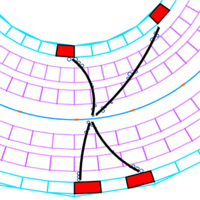
NEMO-3 Quadruple Beta Decay paper selected by PRL editors
Our paper on the “Search for Neutrinoless Quadruple-$\beta$ Decay of $^{150}$Nd with the NEMO-3 Detector”, led by Dr Pawel Guzowski of the University of Manchester, has been chosen as an Editor’s Selection by Physical Review Letters. This is the first search for a decay mode predicted by some theories, which would violate lepton number conservation by four units. No evidence of the decay was seen, enabling us to set a limit on the half life for the process.

SuperNEMO collaboration meets in Prague
The SuperNEMO collaboration summer collaboration meeting took place this year from June 26-28 in Prague, Czech Republic. Physicists travelled across Europe and the world to discuss our progress at this exciting phase of the experiment, when we are installing and commissioning the detector, and preparing analysis software and simulation ready for first data in the coming months.

New SuperNEMO paper on the BiPo-3 detector
The SuperNEMO collaboration has published a paper containing measurements from the BiPo-3 detector. Located in the Canfranc Underground Laboratory in Spain, BiPo-3 is a low-radioactivity detector dedicated to measuring ultra low natural radionuclide contaminations of $^{208}$Tl ($^{232}$Th chain) and $^{214}$Bi ($^{238}$U chain) in thin materials. In particular, it has looked at the thin foils of selenium-82 that will be used as a double-beta decay source in the SuperNEMO experiment. It is vital that we study these decays from natural environmental sources, which can mimic our double-beta decay signal. BiPo-3’s results will be key to understanding these background processes so that we can achieve our goal of being an ultra-low-background experiment.
SuperNEMO and NEMO-3 detectors presented at TIPP
UCL researcher Dr Michele Cascella gave a presentation on the NEMO-3 and SuperNEMO experiments at the TIPP’17 conference. TIPP’17, the International Conference on Technology and Instrumentation in Particle Physics, took place in Beijing, China from May 22-26, 2017.
Congratulations, Dr Xin Ran Liu
Congratulations to Dr Xin Ran Liu, who defended his PhD thesis today, supervised by Professor Ruben Saakyan of University College London. Xin studied the effect of radon on SuperNEMO, studying the radiopure components that will lead to the ultra-low-background detector that we will need to make precision measurements of double beta decays.
 Subscribe via RSS